
120.-
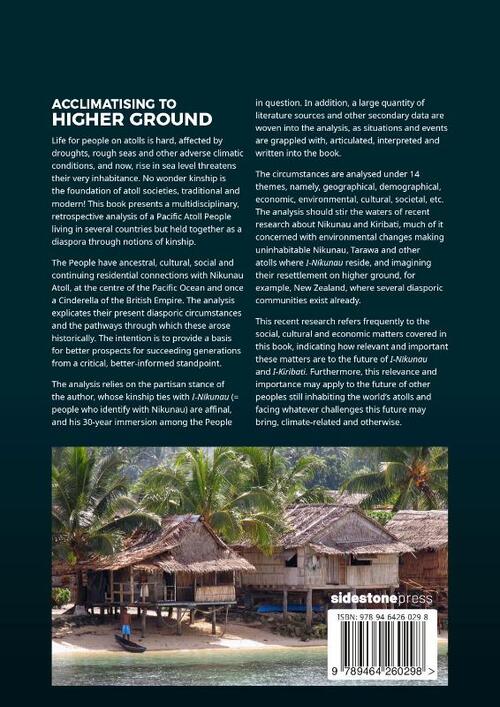
Life for people on atolls is hard, affected by droughts, rough seas and other adverse climatic conditions, and now, rise in sea level threatens their very inhabitance. No wonder kinship is the foundation of atoll societies, traditional and modern! This book presents a multidisciplinary, retrospective analysis of a Pacific Atoll People living in several countries but held together as a diaspora through notions of kinship. The People have ancestral, cultural, social and continuing residential connections with Nikunau Atoll, at the centre of the Pacific Ocean and once a Cinderella of the British Empire. The analysis explicates their present diasporic circumstances and the pathways through which these arose historically. The intention is to provide a basis for better prospects for succeeding generations from a critical, better-informed standpoint. The analysis relies on the partisan stance of the author, whose kinship ties with I-Nikunau (= people who identify with Nikunau) are affinal, and his 30-year immersion among the People in question. In addition, a large quantity of literature sources and other secondary data are woven into the analysis, as situations and events are grappled with, articulated, interpreted and written into the book. The circumstances are analysed under 14 themes, namely, geographical, demographical, economic, environmental, cultural, societal, etc. The analysis should stir the waters of recent research about Nikunau and Kiribati, much of it concerned with environmental changes making uninhabitable Nikunau, Tarawa and other atolls where I-Nikunau reside, and imagining their resettlement on higher ground, for example, New Zealand, where several diasporic communities exist already. This recent research refers frequently to the social, cultural and economic matters covered in this book, indicating how relevant and important these matters are to the future of I-Nikunau and I-Kiribati. Furthermore, this relevance and importance may apply to the future of other peoples still inhabiting the world’s atolls and facing whatever challenges this future may bring, climate-related and otherwise. Contents: I INTRODUCTION 1 Research Approach 1.1 Validity of Chosen Themes 1.2 Validity of I-Nikunau as a Study Identity 1.2.1 Utu 1.3 Empirical Materials 1.4 Intent of Applying My Methods II I-NIKUNAU IN THE PRESENT 2 On Nikunau Atoll 3 On (South) Tarawa 4 Beyond Kiribati 4.1 On Great Britain 4.2 On Te Ika-a-Maui and Te Waipounamu (New Zealand) III RETROSPECTIVE ANALYSIS OF I-NIKUNAU AND INTERPRETATION OF THEIR CIRCUMSTANCES 5 Geographical Circumstances (te mauri) 5.1 Comings and Goings, and Seeds of Diaspora 5.2 Diaspora taking Roots 5.2.1 Tarawa: Centralisation and Precedence 5.2.2 Consequences for I-Nikunau of Centralisation 5.2.3 Phoenix, Solomon and Line Islands 5.2.4 Metropolitan Countries 6 Demographical Circumstances (te mauri) 6.1 Population of I-Nikunau and of Nikunau 6.2 Settlements on Nikunau 6.3 Settlements in the Diaspora 7 Economic Circumstances (te tabomoa) 7.1 Copra and Money and Non-Traditional Entities on Nikunau 7.2 Dynamics of Economic and Related Developments on and Away from Nikunau 7.2.1 Bartering with Foreign Visitors 7.2.2 Private Trade Stores 7.2.3 Cooperative Trade Stores 7.3 Further Aspects of Economic Change in Kiribati 7.3.1 Tarawa’s Economy 7.3.2 Nikunau’s Economy 7.4 Metropolitan Countries 7.4.1 Backwash and Spread Effects on Tarawa from Metropolitan Countries 8 Environmental Circumstances (te mauri) 8.1 Tarawa’s “Worrisome Trend” 8.2 On Nikunau 8.3 Diasporic Communities on Higher Ground 8.4 Climate Change and Emigration 8.4.1 Immigration Information 9 Biological Circumstances (te mauri) 10 Nutritional and Corporeal Circumstances (te mauri) 10.1 On Nikunau 10.2 Tarawa 10.3 New Zealand 11 Political Circumstances (te raoi) 11.1 Government in Kiribati 11.2 From Mwaneaba District Autonomy on Nikunau to Rule from Tarawa 11.2.1 I-Nikunau governing themselves traditionally on Nikunau 11.2.

- : Keith Dixon
- : Sidestone Press
- : 9789464260304
- : Engels
- : Hardcover
- : 260
- : augustus 2021
- : 909
- : 264 x 188 x 22 mm.